Nobuho Nagasawa Japanese

Based in New York since 2001, Nobuho Nagasawa was raised in Europe and Japan, and received her Master’s degree at Hochschule der Künste in Berlin. She came to the United States in 1986 by invitation of the California Institute of the Arts, where she studied art, critical theory, and music. Nagasawa is a transdisciplinary artist whose site-specific and community responsive works explore the politics, ecology, and psychological dimensions of space and people. Her projects range from sculptural installation, architectural intervention, and time-based work to activism, and public art.
Using time and process and community participation as critical components, her environments create experiences that are both tactile and sensory. Her artworks respond poetically to the architectural presence, social and cultural history, collective memory and political consciousness of their sites. Her recent works are shaped by her interest in the intersection of art, science, technology, sound, and synesthesia, a neuro-biological condition where the experiences of the five senses are combined.
She works in unconventional environments outside the mainstream art world and gallery settings. She revitalized a destroyed synagogue site in Berlin, turned abandoned World War II bunkers into motels for lovers, transformed the Turkish penitentiary into a sonic environment, paid tribute to the lost knowledge at the Alexandria Library in Egypt and flew kites with the local community in Fukushima after the nuclear disaster. Her works invite participation from their viewers, and she has collaborated with communities to reveal and address wounds from the past and give dignity to the healing process by juxtaposing the weight of the dark history with resilient and revitalizing poetic gestures.
Nagasawa has participated in over 100 exhibitions internationally which includes; the Royal Garden of the Prague Castle (Czech Republic), Ludwig Museum (Germany and Hungary), Rufino Tamayo Museum (Mexico), Alexandria Library (Egypt), the Getty Center for the History of Art and Humanities (US). She was invited to participate in Asian Art Biennial (Bangladesh, 2002), Book Art Biennial (Egypt, 2002, 2004, 2016), Sharjah Biennial (United Arab Emirates, 2003), Echigo-Tsumari Triennial (Japan, 2003), Sinop Biennial (Turkey, 2006), Setouchi Art Triennial (Japan, 2013, 2016), Fukushima Biennial (Japan, 2012, 2014, 2016), and Nakanojo Biennial (Japan, 2019)
She is a recipient of numerous grants and fellowships including DAAD (German Academic Exchange Service), Berlin State Grant, Rockefeller Grant, California Arts Council Fellowships Award, Brody Arts Fund, and several Japan Foundation Grants. In New York, she was a recipient of the Marie Walsh Sharpe Foundation’s Space Program and Established Artist Fellowships. In 2013, she received the State University Chancellor’s Award for Excellence in Scholarship and Creative Activities.
Her work has been published in books including Japanese Art After 1945: Scream Japanese Against the Sky (Alexandra Munroe, 1994), Lure of the Local: Senses of Place in a Multicentered Society (Lucy Lippard, 1997), Epicenter: San Francisco Bay Area Art Now (Mark Johnstone, Leslie Aboud Holzman, 2002), Art after the Bomb: Iconographies of Trauma in Late Modern Art (Darrell Davisson, 2008), and “Critique of Art about Tenno Emperor System: Beauty and Universalism and Nature (Hiroyuki Arai, 2004). Her work has also been reviewed in Art in America, Art Asia Pacific, Sculpture, The Los Angeles Times, the San Francisco Chronicle, the Pittsburgh Tribune-Review, and The New York Times by Holland Cotter.
In the field of public art, Nagasawa has been commissioned forty projects and has received numerous awards. She has also published master plans and worked in collaboration with architects and engineers for civic projects such as City Halls, government plazas, schools, libraries, parks and transportation projects. She is a three-time recipient of the “Excellence in Design Award,” the highest governments' public art honor, first in Los Angeles (1996) and then in New York (2006 and 2016) given by the Public Design Commissions. In 2019, Hunter's Point South Waterfront Park where she created a sculptural environment entitled “Luminescence” has been named the Best Urban Landscape Masterworks Award from the Municipal Arts Society.
-
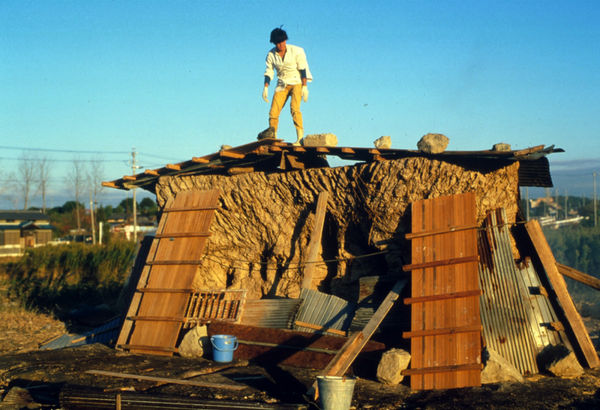
 Noyaki, 1984/2023
 -
Noyaki, 1984
-
Navel of the Earth, 1985
-
Earthworks Process 7, 1987
-
Kiva, 1988
-
Bomb Shelter, 1992
-
Cowboy's Dream, 1992
-
Nuke Cuisine, 1992
-
The Atomic Soldiers, 1992
-
My Home Sweet Home in Ruins, 1992
-
Arcus, 1993
-
Phalz Kapelle (Phalz Chapel), 1994
-
Exterior View of Bunker Motel: Emergency Womb, 1995
-
Interior View of Bunker Motel: Emergency Womb, 1995
-
Orient-a-tion, 1995
-
WA May 13th 1996, 10 A.M. I Called the Pentagon, 1996
-
See Through Eyes, 2003
-
Bodywaves, 2007
-
Umi no Utsuwa (Voyage through the Void), 2013
-
Utsusemi, 2015
-
Luminescence, 2018


-
New Jersey City University
The Atomic Cowboy: The Daze After 17 Sep - 19 Nov 2025To commemorate the 80th anniversary of the atomic bombing of Hiroshima and Nagasaki, transdisciplinary artist Nobuho Nagasawa participates in a dual exhibition at the New Jersey City University Visual Arts...Read more -
Westwood Gallery NYC: 30 Years
6 Sep - 25 Oct 2025In celebration of WESTWOOD GALLERY NYC's 30th Anniversary, the gallery will present a group show highlighting works from artists across our three decade history alongside installation views of past exhibitions.Read more -
8 - Diary of Time
Miriam Bloom, Inger Johanne Grytting, Charles Hinman, Ron Morosan, Nobuho Nagasawa, Don Porcaro, Danny Simmons, Alan Steele 18 Jan - 9 Mar 2024WESTWOOD GALLERY NYC presents 8 - Diary of Time, a group exhibition surveying recent work by eight artists who look to time, past, present, and future in the creation of their artwork.Read more -
Nobuho Nagasawa: Drawn to the Light
A Site-Specific Installation 19 Aug - 16 Oct 2021WESTWOOD GALLERY NYC presents a solo exhibition of an all-encompassing, site-specific installation work by New York artist Nobuho Nagasawa (b. 1959); the artist's first solo show with the gallery.Read more


-
10 Japanese Women Artists You Should Know
Nobuho NagasawaYuki Sumner, Artsy, 7 Oct 2026 -
Westwood Gallery, On Manhattan's Bowery, Marks Its 30th Anniversary
Exhibition ReviewJane Levere, Forbes, 31 Oct 2025 -
Nobuho Nagasawa opens interactive exhibition in New York City
Xenia Gonikberg, The Statesman, 12 Sep 2021 -
Nobuho Nagasawa’s "Drawn to the Light" Opens August 19
Lynne Roth, Stony Brook University News, 13 Aug 2021


-
The Thin Green Line, Parks along Hunter's Point South
Jonathan Lerner, Landscape Architecture Magazine, 12 Mar 2020 -
Hunter’s Point South Park completes a Queens coastline years in the making
Jonathan Hilburg, The Architect's Newspaper, 7 Nov 2019 -
The best public art in NYC
Amy Plitt, Curbed New York, 6 Aug 2018


-
Nobuho Nagasawa Residency at Governors Island
LMCC Arts Center 1 Apr 2026Transdisciplinary artist Nobuho Nagasawa is one of two Stony Brook University professors selected to be year-long Climate Arts residents at the Lower Manhattan Cultural Council's...Read more -
Nobuho Nagasawa at the New Jersey City University Visual Arts Gallery
29 Aug 2025To commemorate the 80th anniversary of the atomic bombing of Hiroshima and Nagasaki, transdisciplinary artist Nobuho Nagasawa participates in a dual exhibition at the New...Read more -
Nobuho Nagasawa at Mori Art Museum
Group Exhibition: Our Ecology, Toward a Planetary Living, 20th Anniversary Exhibition 18 Oct 2023Nobuho Nagsawa's early earthworks Noyaki (1984/2023) and Navel of the Earth (1985/2023) are on view in Our Ecology: Toward a Planetary Living at the Mori...Read more -
Performance, Izumi Ashizawa with Nobuho Nagasawa at Westwood Gallery NY
And, Into Thin Air 2 Oct 2021Performance artist Izumi Ashizawa and Nobuho Nagasawa perform in Ashizawa's collaborative performance And, Into Thin Air at Westwood Gallery NYC. During Nobuho Nagasawa's exhibition Into...Read more


